Visit our Online Sidewalk Sale at BetterWorldBooks.com. Free Carbon Neutral Shipping on all orders in the USA, $3.97 Worldwide.

Thursday, April 30, 2009

Getting Started on a Home Loan


Some of the best advice I can give for getting a home loan is to start early. I’ve included some information in this article to help you get started. Even if your time frame for buying a home is a year away, it’s a good idea to talk with a home loan officer and find out if there is anything you can do to improve your financial status in the mean time. He or she may recommend ways to improve your credit score, and many are trained to help you increase your buying power well before it’s time to buy.

I have included a list of everything you’ll need to get started on your home loan. These requirements are standard for any lender. Depending on the lender, you may not need all of this information upfront, but they’ll request the following at some point during the approval process:

1. Pay stubs for the most recent 30-day period.
2. Bank statements for all your accounts (checking, savings, 401K, etc.) for the last 2 months.
3. W-2 tax statements for the past 2 years (if you’re self-employed or have a commission-based income, you’ll need to provide personal and business tax returns for the past 2 years along with your most current year-to-date profit/loss statement).
4. Employer info (name, phone number, and address) for your most recent 2 years of employment.
5. Address(es) for your residence in the past 2 years (if you’ve rented, you’ll need to give your landlord’s name and phone number).
6. Money for a credit report and appraisal (which is usually $415).

When you’re ready to talk with a lender, be sure to use a good name with a long-standing track record. One of the most important parts of choosing a lender is usually the last thing people think of. Make sure that the lender you choose is actually going to have the money at the closing table. Believe it or not, this has been one of the biggest problems over the past year – and especially in the past few months, since lenders are really having to minimize their risk in giving out loans. Work with a bank that closes on the loans they approve or commit to.

One way to make sure your loan will close is to make sure you’re working with an in house underwriter. This means that when he/she approves a loan, it has already been signed off on and approved. Some home loan officers have to send off the loan to get approved. This is a major benefit of one of the lenders we personally use. Everything is local – even the funding is local. Nothing has to be sent off. Everything is done in house.

When any lenders takes your loan application, they have roughly 300 products (or loan packages) that you may qualify for. Using this large inventory, they find the best product for you. Some brokers have to go to another company to find their products. When this happens, many brokers look for who’s going to pay them the most for sending their loan to a buyer. In these cases, the brokers are not finding what is truly the best loan product for you.

If you need recommendations for lenders, your real estate agent should be able to give you several recommendations of good ones to use. We work with so many lenders that we have a short list of home loan consultants we trust – and consultants who can give you credit counseling. So, if you have any questions, feel free to contact your real estate agent. And, know that it’s never too early to start building your credit for buying a home!

Read more...

Sunday, April 26, 2009

Beauty corner desk


Have you ever wondered who invented the corner desk? No? I didn't think so,but neither had I until recently when I got to thinking, who invented this common, every day piece of office furniture?

Well, if you ever want to stump Google, then this is a good question to ask. I typed in "who invented the corner desk," and the number one return on page one came from the Rabbi's Corner: Did you ever wonder who invented Sunday School? Talk about way off mark! But just in case you are interested, Sunday school for Jewish students was invented in 1838 in Philadelphia by a woman named Rebecca Gratz. I am not Jewish, but at least I now know who to thank for some of my childhood education (and adult since I still attend some form of Sunday school today, currently as a teacher). I wonder if Rebecca Gratz had a corner desk?

Probably not, because the original desk was designed to sit in the middle of a room, or at the front of the room if you were a teacher. Lets take a look at an old style office, often still found today if you are an executive. Someone enters the office, and your desk is in the middle, or back quarter of the room facing the door. In front of your desk (remember, you sit behind the desk) are a couple of chairs for friends or clients (sometimes your clients are your friends). Behind you are some book shelves, a window to one side, and perhaps under the window is a small side bar. Your walls are also graced with classy art, perhaps a portrait of a distinguished great grandfather in his military uniform. You have a safe concealed somewhere, or at least a few hidden compartments in your desk. Your office is finished in rich woods and leather, and is your favorite room in the house.

If you are a teacher, your light pine desk is not so fancy, but still sits at the front of the classroom with your switch and an apple on top.

Now, I do not think that the corner desk evolved from this standard style of antique desk. No, I think it more likely evolved from a roll top desk. Why, do you ask? After all, they do not look anything alike. Remember, this is pure speculation of thought, but who used a roll top desk? Most often a book keeper, or other worker who had a boss. With a roll top desk, you focus on your work at hand, and when you look up, do you see a lush office or view from a window? No, you see little cubby holes and slots that hold more work or are a reminder of the work that you are doing.

Sounds a lot like a corner desk, doesn't it? With the advent of the age of technology and computers, a computer just doesn't fit in a roll top desk very well. Think about it, a corner desk is very functional, as a matter of fact, most modular furniture, that are often in cubicles, are corner desks molded to fit into a small work space. With a corner desk, you sit and look at your computer screen, or books, or items stashed away in small cubbies and shelves on the "hutch". With a corner desk, you do not have lush leather chairs for your clients, or nice art, or a large window to enjoy the view.

A corner desk is practical and functional, and designed for the worker, just like the roll top desk. So, though I cannot say for sure what the history is of the corner desk, I can speculate, and believe that I have come up with a fairly good theory on the evolution of the corner desk.

Read more...

Wednesday, April 15, 2009

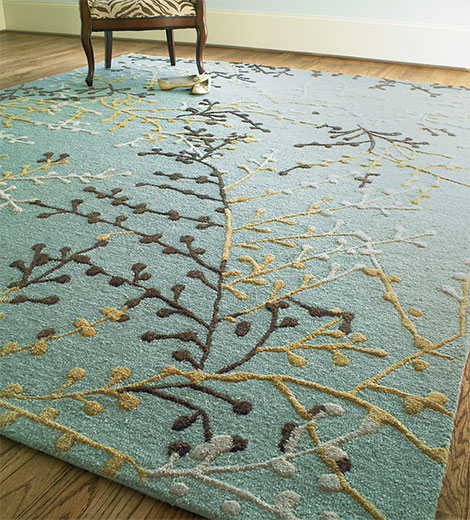
The best area rug


A simple area rug is one of the most versatile and valuable design tools a homeowner will ever find. Whether you're covering, accenting, hiding, or staging, this little carpet is pure gold. It can make an area look bigger, or smaller, and add life to a tired room.

Here are some decorating ideas to help get your creative carpet juices flowing.

For those large rooms with sparse furnishings, a big area rug can add interest to a room and fill in some of the empty space. Make sure the size is neither too big nor too small. The colors should reflect the theme of your house.

Place the carpet in such a way that the furniture can be arranged on the rug. Leave enough space around the carpet so that the floor around the wall is exposed. Suddenly, your room will appear half full instead of half empty.

Open concept floor plans are all the rage in most new neighborhoods, and area rugs can help define spaces without building walls. Take a great room for example, where a living room, dining room and possibly a kitchen are all open. Place a more formal carpet under your dining room table, again slightly smaller than the room, so there is space from the walls.

Separate this with a different area rug (same decorating scheme), in the TV area, and now you have two rooms with no walls. The furniture is anchored to that area and appears like a unique space.

Carpets can also be used to open up entrances and add character. A long narrow runner can add depth to a small foyer and create a walkway to adjacent rooms.

Adding a small rug to the entrance and perhaps a small bench defines the space where someone can enter before removing their shoes. Adding a long narrow rug to the front of a patio door also offers a place to wipe or remove shoes upon entry.

The most common use of area rugs is probably as accents to add interest to different areas of the home.

In the bathroom, try adding two small rugs in front of a double vanity to emphasize the features. A long runner, on the other hand, emphasizes the length of the cabinet.

A long runner down a hall or in a room can expand the area as your eye is drawn down the length of the carpet.

Don't be hesitant to combine solids and bright patterns as long as you remain true to your color scheme. A large, bold pattern can be a focal point in an otherwise neutral shaded room.

In addition to the decorating benefits of an area rug, they also help to muffle sound from voices and reduce foot traffic noise in areas with hard surfaces.

Walking on a soft carpet just plain feels good, and an area rug gives you that luxury in a home that would otherwise be full of floors made from wood or other hard material. It adds warmth and gives you a spot to sit or stretch out and generally creates a more intimate setting.

Read more...

Saturday, April 4, 2009

Prepare your patio


Outdoor Entertaining is A Snap with the Right Accessories

If you’re already thinking about summertime barbeque's, chances are your backyard and patio becomes quite a hot spot during the warmer months of the year. Summer is right around the corner, and now is the perfect time to think about updating your backyard and patio for this season. Simple things like patio furniture, picnic tables, and outdoor porch swings can add excitement to your next outdoor get together. Not only will you be able to use your new outdoor furniture within the next few months, with the right investments, you’ll be able to use these pieces for years to come.

Choosing patio or garden furniture from a place like The Cedar Store, you’ll be investing in strong, dependable accessories. When dealing with outdoor furniture, it’s always important to choose durable items. This rule becomes even more important when dealing with patio furniture. Your purchases not only need to withstand the wear and tear of use, but also different weather conditions. If weather is a major concern, outdoor pavilions make great additions to any backyard and protect you, your guests, and your patio furniture. Although it may seem like a large investment, an outdoor pavilion is a purchase that you’ll cherish and utilize for years to come.

Convenience meets Durability

Properly accessorizing your backyard, patio, or garden can ultimately make or break your summer. For many active gardeners, garden sheds are an absolute life saver during the warmer months. Not having to lug all of your materials out from the garage on a daily basis makes gardening more fun and much easier. Now, you can organize and store all of your tools just a few feet away from your work space. Simple additions like these can add convenience to your home through beautiful, but durable pieces.

Aside from garden sheds, you won’t know your backyard’s full potential until you install these great additions. Think of how much easier your cookouts would be with durable picnic tables rather than dragging all of those folding chairs out from the garage. Although these are simple changes, the benefits from making them are great. So before you start planning the birthday parties, reunions, and get togethers – make sure your backyard, patio, or garden is ready for this season.

Read more...

Friday, April 3, 2009

The best Patio


Patio pavers are made of concrete that is cast into a mold. Pavers can be constructed with various materials like Stone, concrete or brick. Stone is considered the most expensive when compared to concrete or brick. Sandstone, limestone and granite are stones used to make pavers. Concrete pavers are least expensive when compared to other pavers. You can get various designs in brick patios, ranging from classical to contemporary. It is inexpensive in various parts of the country. The longevity of your patio will depend on the quality of the installation. If a patio is constructed poorly it may become loose over time. Do remember certain things before constructing a patio. While constructing a patio, adequate drainage facility is required to prevent damage to your home. A carefully prepared foundation of compacted dirt and several inches of gravel and sand will help preventing shifting of the pavers. It also helps address any lingering drainage problems. See to it that edges of the patio are carefully laid so that you can prevent drifting and wear over time. Some of the advantages of paver patios are as follows:


Paver patios require very little maintenance. While constructing paver patios, people generally use stone, brick and concrete building materials. If a patio is constructed properly, it can easily match the lifetime of your home. Even if a homeowner has lower budget, it can construct a modest patio. One clear advantage of a modular building system is the ability to add on as needed. Some homeowners don’t mind doing the task themselves without seeking professional help. To construct a paver patio it requires little skill, careful preparation and willingness to work hard. Certain tools, like compactor makes the job much easier. If a paver is chipped or cracked, it can be replaced easily. Homeowners should save extra building materials for such repairs, should they become necessary.


Paver patio can be used in many types of homes. Due to low maintenance cost with durability and adaptability it is an attractive option for many homeowners. If you’re concerned about their budget, another type of deck or patio may be a better choice.


Paver patterns vary widely depending on the patio designs being used as well as the aesthetic the homeowner wants to create. Some of the famous paver patterns are Basket Weave, Herringbone, Running bond, Circular, Random etc. Basket Weave pattern are two rectangular pavers that are placed together to form a square. Herringbone is mostly found in traditional designs. If you choose a herringbone pattern, make sure the length of the patio paver is exactly double the width of the paver. A running bond is one of the simplest patterns to create. Random patterns vary greatly depending on the pavers used.

Read more...